by Palden Tsering
Throughout the history of rangeland governance in China, a mix of feudal, communal, and private uses of rangeland have been common.
For example, before the 1950s, in the tsowa system, the land was owned by multiple actors with changing power relationships over its use and access. The tsowa system, was an important social structure comprised of the interdependent relationship between the monastery, tribal leaders, and their members, and had played a crucial role in rangeland governance before the 1950s. Then, from the late 1950s to the early 1980s, the land and the means of production were under the control of State collectives, although private ownership and customary practices continued to remain to some degree.
However, since the 1980s, China’s policies on rangeland governance have been based on the market. This is true, irrespective of whether the goal is to revitalise rural areas, improve the environment, or strengthen private property rights. Through these policies, the State has been able to provide incentives for changing how the land is used. This assumes that there is a stable, controlled form of property with clear patterns of ownership.
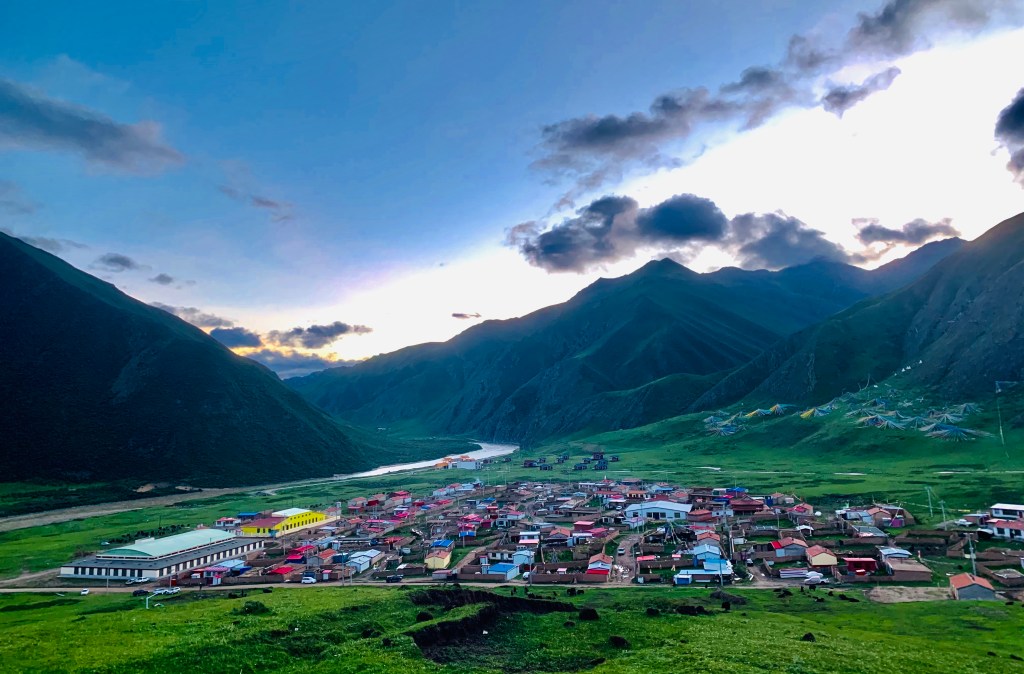
Rangeland governance in pastoral Lumu is based on the ties between the monastery, the Tulku, the local government, and the herders.
In the 1980s, the end of the Cultural Revolution and the growth of the “Great West Open Up” gave Tibetan Buddhist monasteries and monastic institutions a new lease on life. They became strong forces in the local government’s social, political, and economic policies, although the role of the monastery was not limited to making and implementing large-scale policies. It also plays a role in how pastoralists make everyday decisions about how to access and control their land.
Besides, the role of monastic elites, such as the Tulku, shows that when the local elite is capable and recognised by pastoralist communities and the government, and more importantly when such local religious elites show a willingness to support the benefits of the masses, then there is room for these elites to become bricoleurs. In other words, the elites tailor their relationship with the pastoral community and position themselves as an intermediary between the government and the pastoral community.
In a recent piece for the Journal of Land Use Policy, I looked at the role of the monastery in rangeland governance through the lens of assemblage. The paper shows that monasteries in pastoral Lumu give people room to move, shape the values and directions of resource governance, and are important for negotiation-based rangeland management and land policy.
Since 2015, Lumu has received several conservation and development investments from outside. These included a wetland National Park, a hydropower dam project near the monastery, a mineral water factory, and a tourism centre as part of a campaign to reduce poverty.
In 2018, a company from Jiangsu Province, China, made an offer to build a mineral water factory in the village. Villagers say the company offered the contractor 20,000 yuan per year and another 50,000 yuan for the whole village. The company found a piece of land owned by one of the herding families. Tek, the owner of the land and a father of three, said in an interview, “As a herder who does nothing but take care of his flock, we ask the monastery for help. That’s why I talked to the Tulku about the water factory proposal.”

Tek said that the Tulku talked about the pros and cons of building a factory on pastureland and how important it was to save water supplies for the good of everyone. Like Tek, many pastoralists in the village see the monastery and the Tulku as public authorities and legitimate actors who can be trusted to speak for and defend the interests of the many.
After a week, Tek turned down the company’s offer. However, rumours and complaints spread among other pastoral families. Some said that the monastery had taken all the money from the company, and some even went to the county government to report the problem. The Tulku recalls, “The county governor called me one day and told me that some villagers had complaints about the monastery, and it was about the mineral water. I knew rumours were going around, but I didn’t think anyone would complain to the government. That was a shame because all the monastery’s work was done to help the local people and their land.”
This shows how seriously the monastery and the Tulku take their roles. They are trusted to listen and speak up, and they also help the majority figure out what’s going on, in this case, what development means. That is, they can shape discourses that compete with those of a unified government and its representatives.
Different people have different ideas about what land is, and what land is to a government worker is not the same as what it is to a herder or a monk. Land in Lumu is a valuable resource that can be seen from both a mindscape and a scenery point of view. As the cases showed, rangeland use involves many different actors, such as locals, the Tulku, investors, and government officials, who also have different relationships and ways of dealing with uncertainties. In this case, assemblage is the practice of bringing together these different actors and their various goals – reducing poverty, preserving culture, making a living, and having a mutually beneficial relationship – to “intervene in social processes to produce desired outcomes and avoid undesirable ones.”

In Lumu, local pastoralists and the government ask religious elites like Tulku and monastic organisations for the decision-making. Involving these non-official authorities in negotiations is important for building the local political system. The government, the pastoralists, the monastery, and the Tulku all work together to decide how land should be used, who gets permission to use it, how decisions are made, and who has access to rangelands.
In this way, resource governance is about constant coordination, co–production, and co–constitution. It puts the focus on the relationship process, with repeated negotiations and contestations that happen in different social and political situations. The key is this monastery–based resource governance, which hinges on the relationship between the monastery and the monastic town, with the monastery functioning as a mediator between the local government and the pastoralists. In Lumu, the monastery has become the main place where land deals are made, and such a process becomes credible with the decisive role of the Tulku and his powerful networks, as well as the role of the monastery and monastic values on the relationship between humans and nature, secular and non-secular. Therefore, there is a sense of co–production, and the local pastoralists can take part and be involved because of the monastery and Tulku.
However, the continuation of this kind of monastery–based resource governance depends on how the government treats religion and religious institutions. Socio–political changes and policies in these areas would have a big impact on the relationships, social structures, and economic systems that are based on the interdependence of the monastery and the monastic village. So, the monastery–based rangeland governance depends on the presence of the monastery, the way it works, and the power of its representatives in the local society, such as the Tulku. This means that the monastery and the religious leaders lose their power as guardians of the land and people in the local society when they are weak in cultural, economic, and political areas. Therefore, it is harder for local pastoralists and the less powerful to take part in making decisions and shaping politics.
More studies need to be done to find out how this type of rangeland governance affects larger areas, especially where religious institutions like monasteries and other forms of civil society serve as key public authorities that manage community resources. Some studies have shown that monasteries play an important part in rangeland governance, as well as in protecting biodiversity, such as snow leopards, protecting water resources, and promoting sustainable livelihoods.
All these studies look at monasteries from different perspectives and use different methods of inquiry. It is clear that more research is needed to find out what monastery–based governance means for a wider range of resource governance debates in the Chinese context.
 Pastoralism, Uncertainty and Resilience - PASTRES