By M. Fatih Tatari
Turkey hosts many mobile pastoral communities, most of which have become sedentary over the last few centuries. Even the most well-known mobile pastoralist groups still operating in the country often face obstacles to their movements, with consequences for livelihoods, animals and environments.
At the time of writing (5 April 2023), the movements of all animals in Turkey have been banned for three weeks due to foot-and-mouth disease (FMD). This prevents many pastoral communities from travelling with their animals, but it’s also an additional pretext for making it more difficult for local communities to get access to pastures. [1]
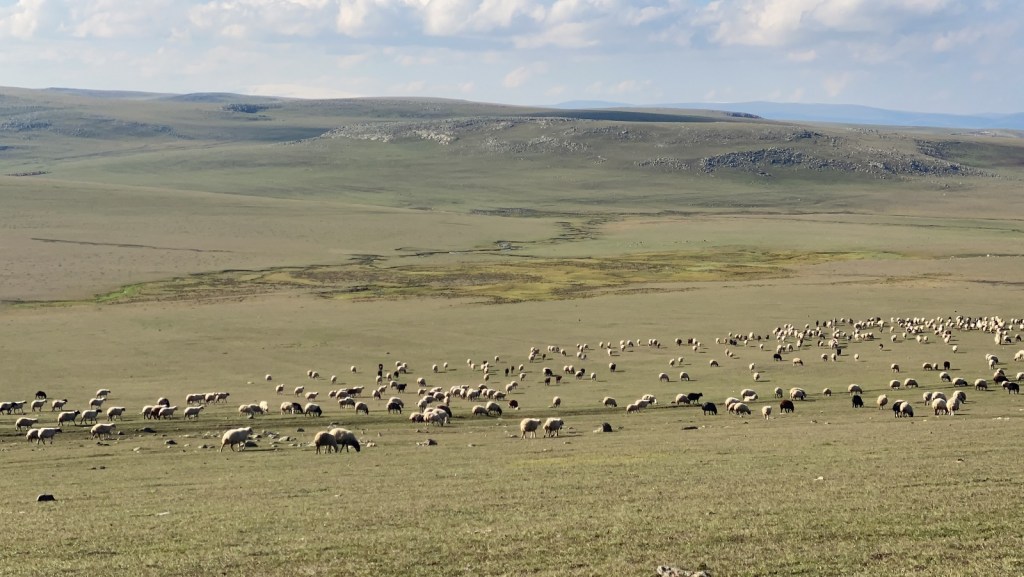
In Northeastern Turkey, the highlands of the plateau stretching from Erzurum to the east, Kars and Ardahan provide vast pastures for ruminants and human communities. Unlike most of the Anatolian landscape, these pastures are suitable for hosting large herds of cows. But like the rest of Eastern Anatolia, they are also home to large flocks of sheep and goats. While family farmers (semi-sedentary) who practise transhumance in the region mainly care for dairy cows, pastoral communities (referred to as göçer/koçer) who spend the winter months in Iğdır (and provinces like Ağrı and others in the South) mostly care for dairy sheep.
Iğdır is a small province surrounded by a high-altitude plateau from Kars, Turkey (West) to Gymri, Armenia (East) in the North, and Ağrı (Ararat) Mountain in the South. The province is situated at the Turkish border with Armenia, Naxçıvan (Azerbaijan) and Iran. Iğdır is famous for its lower altitude micro-climate, which allows a variety of vegetables and fruits to be cultivated here, unlike in the surrounding provinces.
However, the same climate poses a challenge for large flocks of small ruminants, when the weather gets too hot in summer. During the pasture season between April and October, since access to the pastures in the foothills of Ağrı Mountain is limited (also because the state bans pasture access due to national security), pastoral pathways to Ağrı, Kars and Ardahan have always been crucial. Yet these long-distance pastoralist pathways have been constructed, modified, blocked, and circumvented through many centuries along ethnopolitical boundaries and nation-state politics.
Pastures, rents and the state
In Turkey, the use of pastures by sedentary, transhumant, and/or mobile pastoral communities has increasingly been subject to state interventions in the last few decades.
Each village has a particular space designated for pastures, maintained as common grasslands. The village administration (which includes the mayor and the village council) has the right to use (or rent) these commons according to the needs of the villagers.
Depending on the number of animals in the village and the grass available in the commons, the administration can declare a portion of the pastures to be beyond the needs of the village. This portion is usually rented to the villagers who keep animals for meat purposes, usually male calves or sheep which are sold at the end of the pasture season (if not before) and are not considered as a part of the dairy herds that access the common pastures.
If any available pasture remains, it is rented to the people outside the village. While some villagers who do not have access to enough pastures in their village can rent these spaces, most of the renters are mobile pastoralists from Iğdır.
Renting these excess pastures to pastoralists involves complicated procedures. The first step is for the villages to declare the cadastral information of these lands to the provincial branch of the Ministry of Agriculture and Forestry (MoAF). After this, the MoAF announces a list of the pastures available for rent, along with their cadastral and geographical details, the maximum number of animals that these pastures can support, and the minimum rent that must be paid. This announcement serves as an invitation to interested parties to join an auction that is usually held in April or May each year. Each application to the auction must include the number of animals that are being auctioned, along with their ear tag numbers. Since the ownership of the animals is also an issue, the applicant, usually a trusted elderly person from the community, declares ownership or takes responsibility for all the animals present in the pastures.
Although the renting of the pastures through the official auctions generates revenue for the village administration, the auctions (which have only been held in the last decade[2]) have also formalised the rent for pastures and enabled the State to acquire tax revenues from this transaction.
Beyond this financial aspect, I heard complaints from many sedentary and transhumant dairy farming communities in Kars, Ardahan and Iğdır provinces, who say that the presence of large flocks of sheep and goats (larger than initially declared) violate the boundaries of the assigned pastures. Farmers in Kars and Ardahan are usually concerned about contagious diseases such as FMD which they believe increase with the presence of sheep from Iğdır. The risk of contagion is the reason that pastures of cows and sheep tend to be strictly separated in most villages. When the flocks from Iğdır end up grazing in the pastures reserved for the village’s herds of dairy cows, either because their rented pasture does not suffice, or because they must trespass to access their rented pastures, it makes the cow herders anxious.
Pastoralists, for their part, have always had to make agreements with the mayors (muhtar) and the elderly of a village to use their pastures. They have been unable to bypass the State in the last several years, except in using pastures that are privately owned. What is more, in the summer of 2019, the prefecture (vali) [3]of Ardahan banned the entry of all ruminants into the province from outside its administrative borders. For reasons of security and reports of overgrazing, the movement of animals and pastoralists to Ardahan was declared suspicious and detrimental to the pastures. This decree was announced as part of the Large and Small Ruminant Livestock Action Plan of the province, which aims ‘to support local producers’[4].
This Action Plan does not consider the pastoral communities who have always been a part of the pastures and have been involved in animal care in the province as outsiders – neither does it consider the benefits of grazing practices on pastures. The conflicts between ‘local producers’ and ‘pastoralists’ are taken for granted, declaring the latter as responsible for the damage to the pastures.
Restrictions on movement
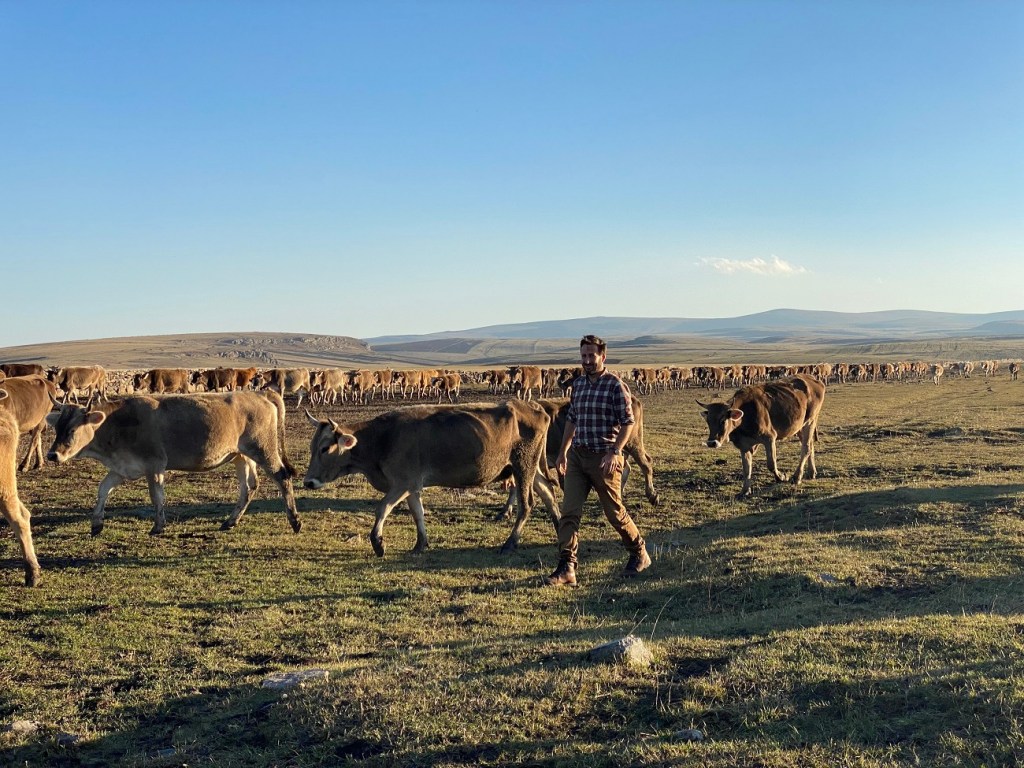
My encounter with Boran[5], a shepherd, in Kars, epitomizes some of the impacts of this policy. Pasturing hundreds of kilometres away from his hometown in Iğdır, Boran used to travel to the pastures of Ardahan from May to October each year, either with cows of the farmers who paid him or with sheep of his own family and village.
In 2021, I met him in Boğatepe village, Kars, where he was employed as a shepherd by a few farmers to look after one of the four herds of the village. Boran explained to me that he was not able to travel to Ardahan since the year 2019 due to a pasture ban on pastoralists. He explained to me that he was part of a group that managed to bypass the ban by entering into an agreement with a farmer from Ardahan. According to the agreement, the farmer ‘bought’ sheep from the pastoralists, and would ‘sell them back’ at the end of the pasture season.
Subsequently, Boran and two other shepherds were travelling in a truck with the sheep when they were stopped by soldiers who did not allow them to pass through, even though the animals belonged to a farmer in Ardahan. The decree stated that no shepherd would be allowed to pass with animals, irrespective of the ownership of the animals. Although they tried convincing the soldiers, their arguments were unsuccessful, and after several hours of waiting for a resolution, the army escorted the truck to the administrative borders of Iğdır. The whole trip took almost 24 hours, and dozens of sheep either succumbed or were left severely injured.
After this catastrophic attempt, the remaining animals were sold since they could not be taken to the pastures. Boran went to work as a construction worker in a big city, where he usually spends the winter months and contributes to his family’s income. In the summers of 2020 and 2021, he was employed as a shepherd in Boğatepe village.
In 2022, the ban was lifted, but ‘pastoralist families’ who were interested in renting pastures were asked to reside in Ardahan for at least six months before submitting fresh applications. Since 2019, Boran’s family had lost almost half of their sheep, which drove Boran to choose to work in construction again. When I recently talked to him this spring, he told me that the pastoral communities are impatiently waiting to hear from the MoAF about the auctions, as they must start moving in April, before the weather gets hot in Iğdır.
Each year, countless flocks, comprising hundreds of thousands of sheep and goats, travel the pastures in Northeastern Turkey. Although these movements must be undertaken with the help of trucks and other vehicles, most pastoral communities continue to prefer to walk, especially at the end of the pasture season, in October, when their flocks include many pregnant animals and newborns.
There is no official record of the pastoral communities, their movements, and their effects on the pastures. The policies that exclude pastoralists have detrimental impacts on the very pastures they aim to protect. Conservation of the pastures needs to include pastoralists and farmers, and their wisdom, but also the right tools designed to include them.
Notes
[1] An example can be shown in the recent social media posts of the Sarıkeçililer who move between winter settlements (kışlak) in Mersin and summer pastures (yazlak) in Konya.
[2] The state intervened in the process since some mayors would charge high prices from the pastoralists without the village administration or villagers being aware of it. The official auction aimed to prevent this bribery while at the same time controlling the number of ruminants using the pastures which can also be monitored in ideal scenarios.
[3] See: https://www.haberturk.com/ardahan-haberleri/75553342-meralara-gocerlerin-girmesi-yasaklandi
and http://www.ardahan.gov.tr/meralarin-korunmasi-200519
[4] See: http://www.ardahan.gov.tr/2019-yili-il-buyukbas-ve-kucukbas-hayvancilik-eylem-plani
[5] Pseudonym is used.
 Pastoralism, Uncertainty and Resilience - PASTRES