
This lecture discusses some of the controversies about the relationships between livestock, biodiversity protection and environmental conservation. The lecture emphasises the importance of understanding rangelands as non-equilibrium, open ecosystems. All rangelands have co-evolved with large herbivores and fire, both of which are ‘natural’, essential elements of such ecosystems.
There are various ways that extensive, mobile livestock can enhance biodiversity, including creating connections between fragmented patches through transhumant corridors, the spreading of seeds through mobile livestock, the importance of key resources for both livestock grazing and as important wildlife habitats, the value of livestock systems for rare ‘keystone species’ and the value of local genetic resources and breeding systems for biodiversity.
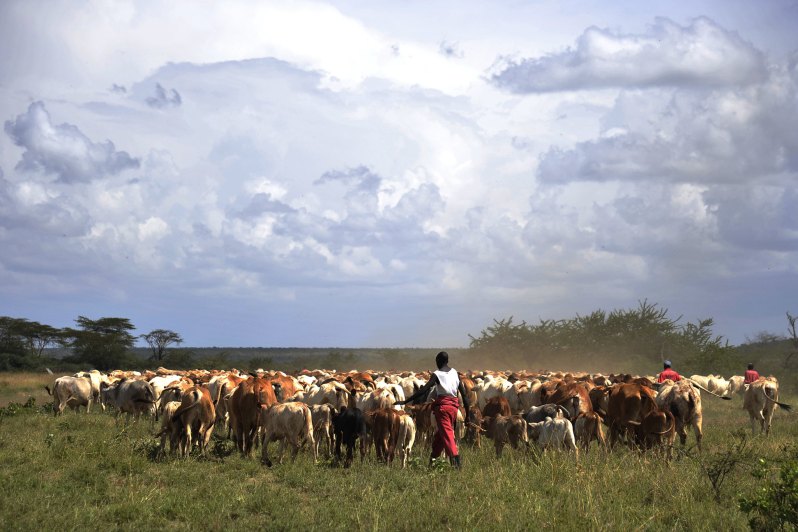
Instead of top-down, control-oriented environmental protection – such as mass tree planting or exclusionary ‘rewilding’ – the lecture argues for a collaborative, ‘convivial’ form of conservation that sees people and livestock as central to environmental protection.
 Watch the lecture
 Questions
- What are the key ecological characteristics of rangelands? How do these characteristics differ from other ecosystems, such as closed forests?
- What are the disadvantages of mass tree planting in rangelands?
- What are the ways that pastoralism can enhance biodiversity?
- What are the differences between conventional approaches to conservation and more collaborative alternatives? How does this affect pastoralists?
 Readings
PASTRES produced a series of briefings in advance of the biodiversity COP in 2022. These six briefings offer an overview of the key arguments, as well as further references.
- The benefits of pastoralism for biodiversity and the climate
- Why tree planting in rangelands can be bad for biodiversity and the climate
- Enhancing biodiversity through livestock keeping
- Going up in smoke: how livestock keeping can reduce wildfires
- Rewilding and ecosystem restoration: what is ‘natural’?
- Collaborative conservation: pastoralists as conservationists
A short summary article is also available here: How pastoral farming can help to avoid a biodiversity crisis (theconversation.com)
Videos
▶ Biodiversity and pastoralism
▶ Pastoralism, biodiversity and health: Why pastoralists must be central to nature conservation
▶ The Case for Convivial Conservation
Further reading
- Bond, W. et al. (2019) The trouble with trees: afforestation plans for Africa. Trends in Ecology & Evolution 34(11): 963-965
- Davis, D.K. and Robbins, P. (2018) Ecologies of the colonial present: Pathological forestry from the taux de boisement to civilized plantations, Environment and Planning E: Nature and Space 1(4): :4 (447-469)
- Fleischman, F. et al., (2020) Pitfalls of tree planting show why we need people-centered natural climate solutions. BioScience, 70(11):947-950
- ILRI, IUCN, FAO, WWF, UNEP and ILC (2021) Rangelands Atlas. Nairobi Kenya: ILRI.
- Krätli S. and Provenza F. (2021), Crossbreeding or not crossbreeding? That is not the question – PASTRES blog
- Manzano Baena, P. and Casas, R. (2010) Past, present and future of transhumancia in Spain: Nomadism in a developed country. Pastoralism 1(1): 73-90.
- Manzano, P. and Malo, I.E. (2006). Extreme long-distance seed dispersal via sheep. Frontiers in Ecology and the Environment 4: 244–248.
- Nori M. and Berzi D. (2021) The Uncertainties of Co-Existing with Predators: Experiences from southern Europe – PASTRES blog
- Pyne, S. 2020, Our Burning Planet: Why We Must Learn To Live With Fire, Yale Environment 360 website, October 2020.
- Yılmaz E., Zogib L., Urivelarrea P. and Çağlayan S.D. (2019) Mobile pastoralism and protected areas: Conflict, collaboration and connectivity, PARKS 25(1)
 Pastoralism, Uncertainty and Resilience - PASTRES